Berlin · 2026

OkiNoWar WEEK

What Can We Learn from and with Okinawa?
From a History of Division, We Choose to Live Together.

Was können wir von und mit Okinawa lernen?
Aus einer Geschichte der Teilung wählen wir das Zusammenleben.

Sinema Transtopia
HKW Haus der Kulturen der Welt
SAVVY Contemporary

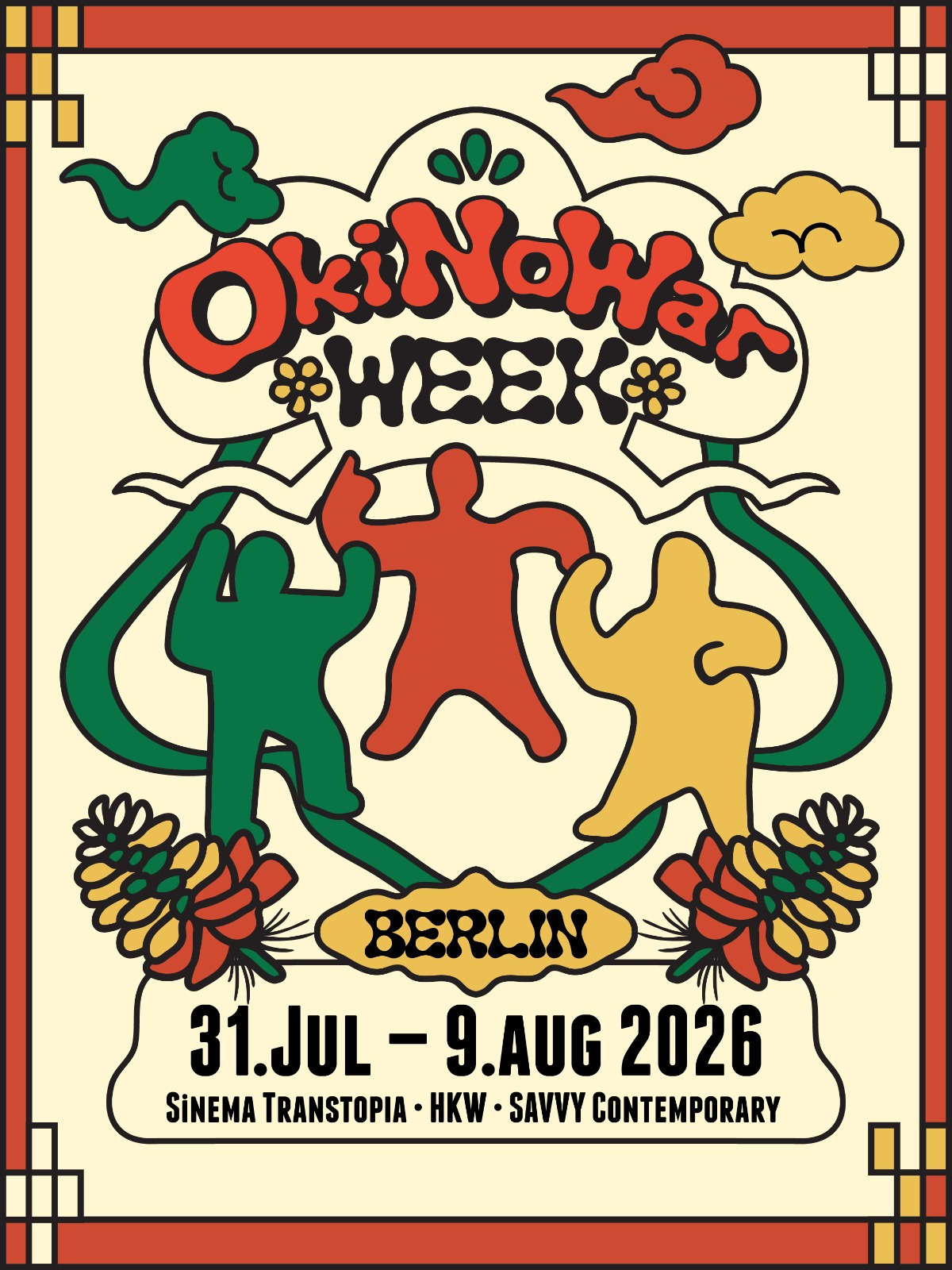
OkiNoWar WEEK 2026 poster — three dancing figures, Okinawan flowers, Berlin

01

About Über

OkiNoWar WEEK is an international cultural project that brings Okinawa into a wider global conversation on colonialism, militarism, non-violence, human rights, sovereignty, identity, and collective memory.

The name combines "Okinawa" and "No War." It carries both a refusal — not to allow Okinawa to become a frontline of war again — and a commitment to share the knowledge, philosophies, and cultural practices that Okinawan people have carried through histories of violence, occupation, displacement, and cultural suppression.

Through Ryūkyūan performing arts, crafts, karate, film, photography, contemporary art, and dialogue, OkiNoWar WEEK approaches culture not simply as heritage to be preserved, but as a living form of knowledge — one through which memory, identity, resistance, care, and ways of living together continue to be practiced and reimagined.

What can we learn from and with Okinawa?

OkiNoWar WEEK seeks to create a space where Okinawa can speak in its own voices, through its own bodies, memories, and forms of expression — and where these experiences can enter into dialogue with the world.

OkiNoWar WEEK ist ein internationales Kulturprojekt, das Okinawa in einen breiteren globalen Diskurs über Kolonialismus, Militarismus, Gewaltlosigkeit, Menschenrechte, Souveränität, Identität und kollektive Erinnerung einbringt.

Der Name verbindet „Okinawa" und „No War" (Kein Krieg). Er trägt sowohl eine Weigerung — Okinawa soll nie wieder zur Frontlinie des Krieges werden — als auch das Bestreben, das Wissen, die Philosophien und kulturellen Praktiken weiterzugeben, die die Menschen Okinawas durch Geschichten von Gewalt, Besatzung, Vertreibung und kultureller Unterdrückung bewahrt haben.

Durch ryūkyūanische darstellende Künste, Handwerk, Karate, Film, Fotografie, zeitgenössische Kunst und Dialog begreift OkiNoWar WEEK Kultur nicht einfach als zu bewahrendes Erbe, sondern als lebendige Form des Wissens — eine, durch die Erinnerung, Identität, Widerstand, Fürsorge und Wege des Zusammenlebens weiterhin praktiziert und neu gedacht werden.

Was können wir von und mit Okinawa lernen?

OkiNoWar WEEK möchte einen Raum schaffen, in dem Okinawa mit eigener Stimme sprechen kann — durch eigene Körper, Erinnerungen und Ausdrucksformen — und in dem diese Erfahrungen in einen Dialog mit der Welt treten können.


02

Program Programm


03

Three Venues,
One Vision
Drei Orte,
eine Vision

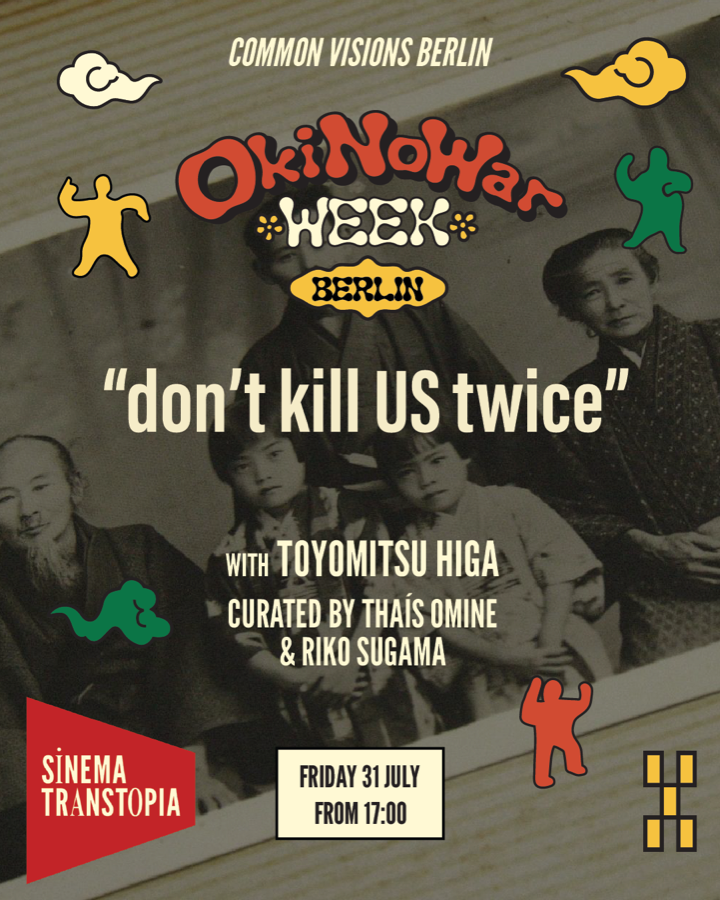
Don't Kill Us Twice — event poster 01

Sinema Transtopia — July 31

Sinema Transtopia — 31. Juli

Don't Kill Us Twice

Okinawa was not simply colonized; the Ryukyu Kingdom was dismantled, and its language, land, culture, and memory were taken away. In 1945, Okinawa was used as a "sacrificial shield" — over 120,000 people lost their lives. This was the first death. After the war, with the concentration of U.S. military bases, the war never truly ended. The soil containing the remains of war victims is now being used for the construction of the new Henoko military base. The dead being used once again for militarization — this is the second death.

Okinawa wurde nicht einfach kolonisiert; das Königreich Ryukyu wurde aufgelöst, und seine Sprache, sein Land, seine Kultur und seine Erinnerung wurden weggenommen. 1945 wurde Okinawa als „Opferschild" benutzt — über 120.000 Menschen verloren ihr Leben. Dies war der erste Tod. Nach dem Krieg endete der Krieg nie wirklich. Die Erde, die die Überreste der Kriegsopfer enthält, wird nun für den Bau des neuen Militärstützpunkts Henoko verwendet. Dies ist der zweite Tod.

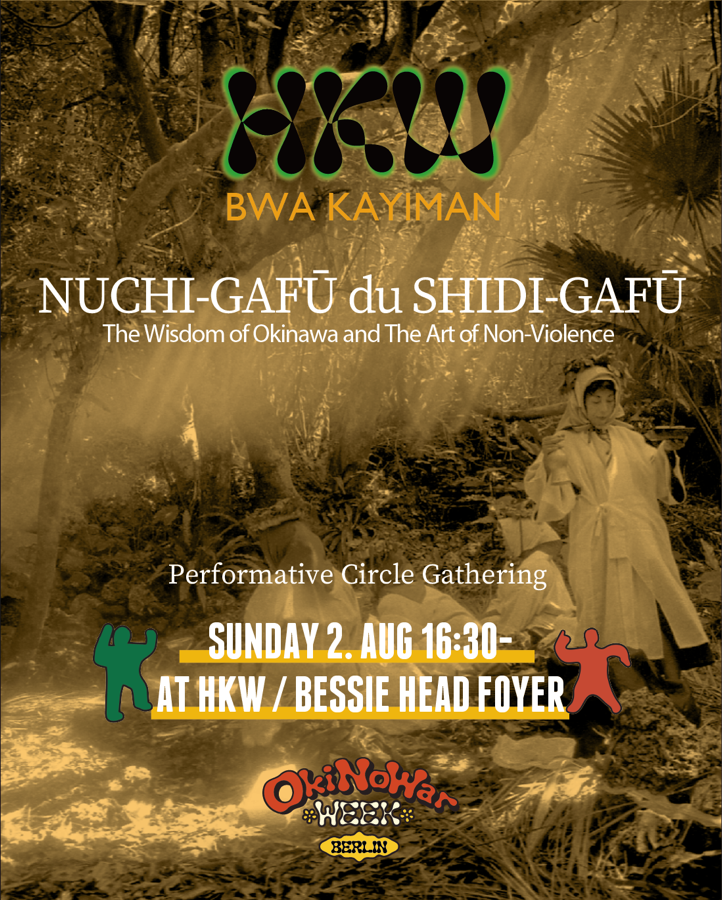
Nuchi-Gafū du Shidi-Gafū — event poster 02

HKW — August 2, 16:30–18:30

HKW — 2. August, 16:30–18:30

Nuchi-Gafū du Shidi-Gafū

The Wisdom of Okinawa and The Art of Non-Violence

Die Weisheit Okinawas und die Kunst der Gewaltlosigkeit

"Nuchi Gafū du Shidi Gafū" expresses gratitude that life — yours and mine — has been born through generations and exists here now, and the wish to share and celebrate that happiness together. Not a historical lecture, but a participatory performance gathering within a circular space arranged like a living room. At the center: Is non-violence weakness, or is it a culturally chosen way of living?

„Nuchi Gafū du Shidi Gafū" drückt die Dankbarkeit dafür aus, dass das Leben — deins und meins — durch Generationen geboren wurde und jetzt hier existiert. Keine historische Vorlesung, sondern eine partizipative Performance-Versammlung in einem kreisförmigen Raum. Im Zentrum: Ist Gewaltlosigkeit Schwäche, oder ist sie eine kulturell gewählte Lebensweise?

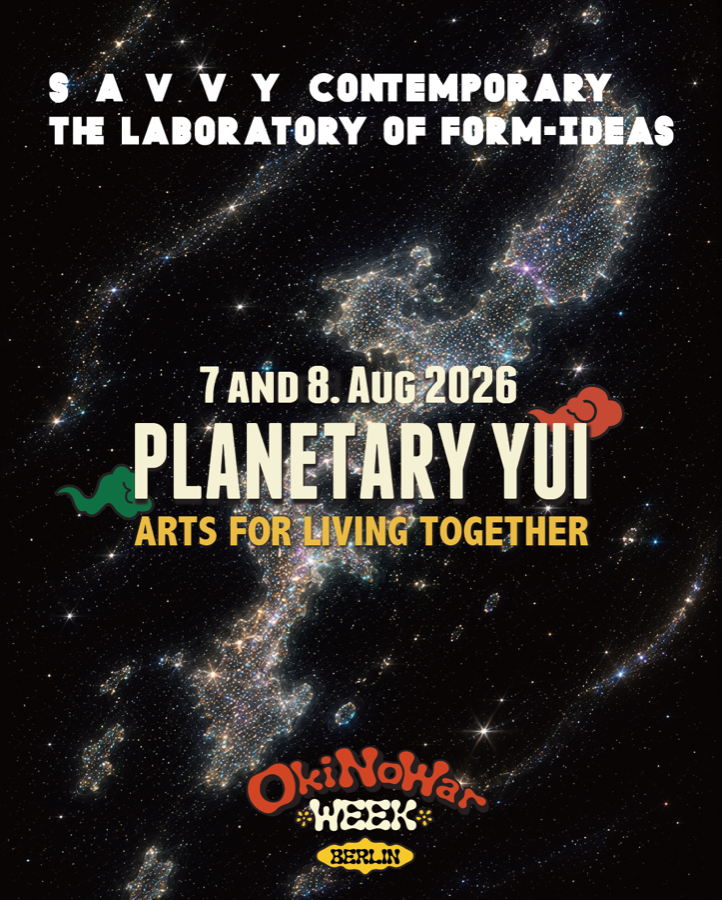
Planetary YUI — event poster 03

SAVVY Contemporary — August 7–8

SAVVY Contemporary — 7.–8. August

Planetary YUI

Arts for Living Together

Kunst für das Zusammenleben

YUI means "to connect," "mutual help," and "living together" in Okinawan culture. Planetary YUI expands that philosophy toward a planetary community — connecting Berlin, São Paulo, and Okinawa through the Okinawan diaspora. Exhibitions, workshops in Ryukyuan dance, uta-sanshin, calligraphy, and karate, and a closing gathering.

YUI bedeutet „verbinden", „gegenseitige Hilfe" und „zusammenleben". Planetary YUI erweitert diese Philosophie in Richtung einer planetaren Gemeinschaft — Berlin, São Paulo und Okinawa durch die okinawanische Diaspora verbindend. Ausstellungen, Workshops und eine Abschlussveranstaltung.

"Once we meet,
we become brothers and sisters."
„Wenn wir uns einmal begegnen,
werden wir Geschwister."

— Ichariba Chōdē

"There is no first
attack in karate."
„Im Karate gibt es
keinen ersten Angriff."

— Karate ni sente nashi

Non-violence is not weakness.
It is a consciously chosen
cultural way of living.
Gewaltlosigkeit ist keine Schwäche.
Sie ist eine bewusst gewählte
kulturelle Lebensweise.

04

Artists &
Contributors
Künstler:innen &
Mitwirkende

Riko Sugama

Founder & Artistic Director of OkiNoWar WEEK Project

Gründerin & Künstlerische Leiterin des OkiNoWar WEEK Projekts

Toyomitsu Higa

Photographer & Guest Speaker

Fotograf & Gast-Sprecher

Hiroya Maeda

Artist, Educator & Urushi Lacquer / Raden Artist

Künstler, Pädagoge & Urushi-Lack- / Raden-Künstler

Nanyō Unten

Calligrapher — Carrying Forward Ryukyuan History & Language

Kalligrafin — Bewahrerin ryukyuanischer Geschichte und Sprache

Aki Maeda

Urushi Lacquer & Raden Artist — Contemporary Artist

Urushi-Lack- & Raden-Künstler — Zeitgenössischer Künstler

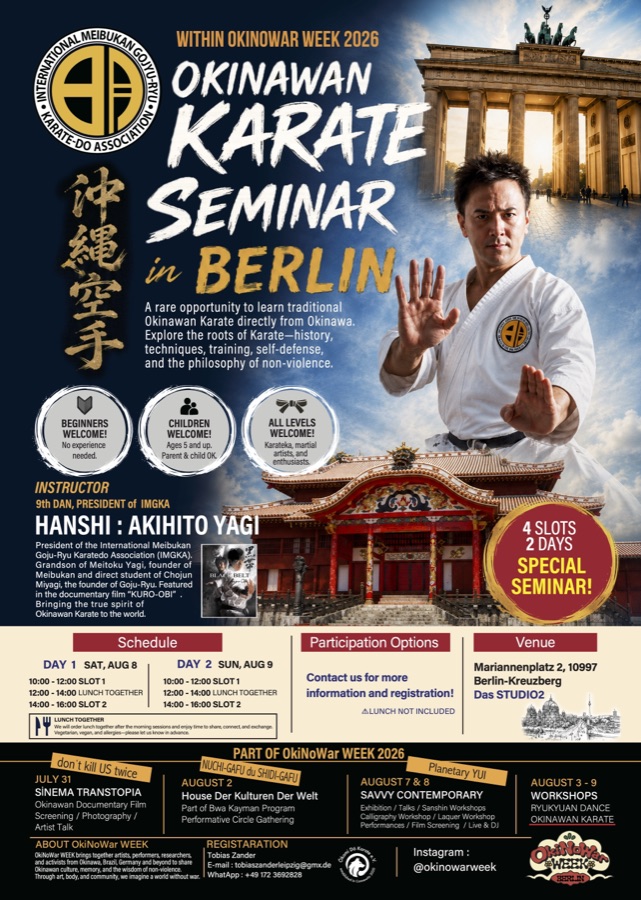
Akihito Yagi

Karate Master & Teacher of Okinawan Martial Philosophy

Karate-Meister & Lehrer okinawanischer Kampfphilosophie

Ayaka Nakazato

Ryukyuan Dance Performer & Master of Ryukyu Traditional Dance

Ryukyuanische Tänzerin & Meisterin des traditionellen Ryukyu-Tanzes

Rita Sugama

Ryukyuan Dance Performer & Master of Ryukyu Traditional Dance

Ryukyuanische Tänzerin & Meisterin des traditionellen Ryukyu-Tanzes

Takumi Hosokawa

Singer-Sanshin Performer & Master of Ryukyu Traditional Music

Sänger und Sanshin-Musiker & Meister traditioneller Ryukyu-Musik

Victor Kinjo

Artist, Musician, Composer & Diaspora Researcher

Künstler, Musiker, Komponist & Diaspora-Forscher

Thaís Omine

Filmmaker, Visual Anthropologist & Film Program Curator of OkiNoWar WEEK

Filmemacherin, Visuelle Anthropologin & Filmprogramm-Kuratorin von OkiNoWar WEEK

Makoto Inoue

Techno Producer & Visual Artist — Performance & Technical Director for OkiNoWar WEEK

Techno-Produzent & Visueller Künstler — Performance- & Technische Leitung für OkiNoWar WEEK

Micaela Trigo

Creative Producer & Culture Connector

Kreativproduzentin & Kulturvermittlerin

Project Support Projektunterstützung

Minwoo Kim

Visual Identity & Graphic Designer

Visuelle Identität & Grafikdesign

Yoko Gross

Translator & Interpreter

Übersetzerin & Dolmetscherin

Kanako Sugiyama

Cultural Connector

Kulturvermittlerin

Hinako Tamaki

Project Support

Projektunterstützung

Jiani Yu

Documentary Photography & Video

Dokumentarfotografie & Video

SUPPORTED BY

259 Crowdfunding Supporters 259 Crowdfunding-Unterstützer:innen

TsukAya · J&L Taira · 流星 · 麻枝

細川綾香 · 香織 · 愛里 · ATTEO.inc · Ria Ideta · ジュエルカフェ

Aya · フレディ · 葛西太郎 · 鈴木佐和子 · マサヨ · Seiya · 神山邦夫 · shellybuku · 金城花蓮 · Zen · マブイ · Ryota Nakaoka · YA · yuka · Harumi · sjtanuki · ジャンボ · 安里愛 · mayumi.k · 運天達也 · 玉榮雅代 · Takeda2 · otsuka t · まるなか · 美音 · Gin Yui · Taira Ohana · Yuki · Unknown · karen

仲村智子 · 添石幸伸 · Sandy Kanako Tsutsumi · Miki Itokazu · ぴろぴろ · HY · chara · moon21 · ほゆき · Tommy · 仲里千枝子 · temu_mam · よう · WongFaye · @suko · 大嶺美幸 · 仲宗根生美 · Jiro · REIKO · リエ · Karin · Yuuki Gowgiel · Misaki · hirooimaki · 峰一 · 宮里 寿子 · Naomi.A · kana · 日文太郎 · よっこー · okineko · 克也 · はる · osamu · 富原ケイティ · 渡名喜広美 · Chieko Seki · senri · YT · tida · ひろみねーねー · taekoyamada · IhaHiro · まじる商店 · 小川未加 · 渡名喜 · tetstya · 清水啓子 · ひだか · AGUEMANITY · Takeshi Maeda · ナカマノブエ · 安達哲也 · ami · kanon · めんめ · O.A.Mika · iha makiko · 齋藤龍之介 · 上里邦子 · バズ · Aoi · よっぴー · クラフトキャビン · るみ · 鹿島安虎 · 君島弘子 · あおい · ベルリン発酵ママかずみ · 具志堅州 · 宮城克美 · 松元雄子 · ゆうき · キンジョウ リュウジ · Evergreen · readyforoui · miitudii · おおまり澤井毎里子 · YokoKimuraGross · たまき · Kotoko · che · runo · SUNTOLUNA · Noa · tomo · めかけん · TOYOMU · Kanako · ノハラ · 棚原健太 · sardine17 · kyoko · Rinokinawa · 洌鎌良太 · Nakasone · カナコ · 真緒 · waka · すま · YamaIko · みかどんどん · 十七美 · 麻希 · 根間芳和 · 池宮城友子 · 玉元三奈美 · Chiemi Miyata · MIYA UNTEN · noriko · Uta Hosokawa · 宮城光也 · ごーつ(郷津桂一) · 永山忍 · 南天 · 笹路香織 · 森安伸介 · 野上千織 · haru · ノリヒロ · みっこ · 狩俣芳美 · 渡久地 · 仲村さやか · てん · 古謝渚 · Sachiko · 東風平ももぴぃ · seiko · Maï Adeline · GARYU TOKESHI · ディライトファーム · komakoren · poooki.no · ひらはるおやはる · YT · Nephews · ryokk · tae.shinjoh · Nanako · Kentaro.H · 宮里瞳 · Leo · 音佳 · 松浦雅子


05

Why
Okinawa
Warum
Okinawa

Okinawa's history is not Okinawa's alone.

For decades, the questions surrounding Okinawa have often been framed primarily through the political relationship between Japan and the United States. Yet Okinawa's history and present raise questions that belong to a much wider international discussion.

The dissolution of the Ryūkyū Kingdom, assimilation and cultural suppression, the Battle of Okinawa, U.S. military rule, migration and diaspora, and the continuing concentration of military bases are connected to broader histories of colonialism, militarism, displacement, sovereignty, and the struggle for cultural and political self-determination.

OkiNoWar WEEK seeks to open these questions beyond a bilateral political framework and into an international public sphere.

By placing Okinawa in dialogue with other histories of colonization, violence, displacement, resistance, and survival, the project aims to expand international understanding and build forms of solidarity across borders.

At the same time, it asks what can be learned from the cultural practices that have sustained Okinawan communities across generations — from performance, music, craft, prayer, and martial arts to collective memory and mutual care.

The project began through an invitation to participate in Bwa Kayiman, an international programme at Haus der Kulturen der Welt (HKW) in Berlin, and subsequently expanded into a ten-day programme across SİNEMA TRANSTOPIA, HKW, and SAVVY Contemporary. It brings together artists, cultural practitioners, researchers, and members of the Okinawan diaspora from Okinawa, Brazil, and Berlin.

From Okinawa to the world — and from the world, back to Okinawa.

OkiNoWar WEEK is an attempt to share these questions with a wider public, to create new international relationships around them, and to carry the conversations that emerge forward to future generations.

Okinawas Geschichte gehört nicht allein Okinawa.

Jahrzehntelang wurden die Fragen rund um Okinawa vor allem durch die politische Beziehung zwischen Japan und den USA gerahmt. Doch Okinawas Geschichte und Gegenwart werfen Fragen auf, die einer viel weiteren internationalen Diskussion angehören.

Die Auflösung des Ryūkyū-Königreichs, Assimilation und kulturelle Unterdrückung, die Schlacht um Okinawa, die US-Militärherrschaft, Migration und Diaspora sowie die andauernde Konzentration von Militärbasen stehen in Verbindung mit umfassenderen Geschichten von Kolonialismus, Militarismus, Vertreibung, Souveränität und dem Kampf um kulturelle und politische Selbstbestimmung.

OkiNoWar WEEK möchte diese Fragen über einen bilateralen politischen Rahmen hinaus in eine internationale Öffentlichkeit öffnen.

Indem Okinawa in Dialog mit anderen Geschichten von Kolonisierung, Gewalt, Vertreibung, Widerstand und Überleben tritt, will das Projekt internationales Verständnis erweitern und grenzüberschreitende Formen der Solidarität aufbauen.

Gleichzeitig fragt es, was sich von den kulturellen Praktiken lernen lässt, die okinawanische Gemeinschaften über Generationen hinweg getragen haben — von Performance, Musik, Handwerk und Gebet bis zu Kampfkunst, kollektiver Erinnerung und gegenseitiger Fürsorge.

Das Projekt begann mit einer Einladung zur Teilnahme an Bwa Kayiman, einem internationalen Programm des Haus der Kulturen der Welt (HKW) in Berlin, und wurde anschließend zu einem zehntägigen Programm an SİNEMA TRANSTOPIA, HKW und SAVVY Contemporary erweitert. Es bringt Künstler:innen, Kulturschaffende, Forschende und Mitglieder der okinawanischen Diaspora aus Okinawa, Brasilien und Berlin zusammen.

Von Okinawa in die Welt — und von der Welt zurück nach Okinawa.

OkiNoWar WEEK ist der Versuch, diese Fragen mit einer breiteren Öffentlichkeit zu teilen, neue internationale Beziehungen um sie herum zu schaffen und die daraus entstehenden Gespräche an künftige Generationen weiterzutragen.

Haus der Kulturen der Welt (HKW)
SAVVY Contemporary
Sinema Transtopia
Micaela Trigo
Kaikô — Opening Doors
Readyfor
Kugani Hama (クガニ浜) — TOYOMU Created by Okinawan artist TOYOMU in support of OkiNoWar WEEK's crowdfunding campaign — carrying the project's spirit of The Wisdom of Non-Violence through music. Geschaffen vom okinawanischen Künstler TOYOMU zur Unterstützung der Crowdfunding-Kampagne von OkiNoWar WEEK — trägt den Geist des Projekts, die Weisheit der Gewaltlosigkeit, durch Musik weiter.
Listen on Bandcamp Auf Bandcamp hören